Garbage Collector – What It Is and Why Every Developer Should Understand It
Most developers have encountered a situation where an application starts behaving strangely without an obvious cause. Memory usage grows gradually, response times deteriorate, and eventually someone suggests restarting the service. Often that helps, at least temporarily. The problem itself, however, is rarely resolved. It merely disappears from view, only to return later, perhaps in a different form, perhaps when the system is under heavier load.
Surprisingly often, attention is directed toward the wrong places. Developers search for faults in algorithms, databases, or network layers, even though the real explanatory factor is far more fundamental. The issue is that the developer does not fully understand what the language runtime is doing on their behalf. One of the most critical, yet least clearly understood, components of that runtime is the garbage collector.
The garbage collector is not a minor implementation detail or a peripheral feature. In many languages, it is a core part of the execution model. If it is not understood, the behavior of the application in production cannot truly be understood either.
What a Garbage Collector Actually Is
Garbage collection is often described as if it were a background cleaner that occasionally frees unused memory. The metaphor is appealing, but misleading. A garbage collector is neither an invisible helper nor a free convenience feature. It is an active runtime system that makes decisions on behalf of your program.
Concretely, the garbage collector decides when memory is reclaimed. It does not ask for permission from the developer, nor does it follow the implicit intentions expressed in the code. It operates according to its own model and heuristics. By using a garbage-collected language, the developer relinquishes control over the timing of memory reclamation. In exchange, they gain safety, faster development, and fewer classes of memory-management errors.
This is not a flaw or a weakness. It is a deliberate trade-off. What matters is understanding that responsibility does not disappear. It simply shifts from the developer to the runtime system.
Why Garbage Collection Was Invented
Without a garbage collector, the developer is responsible for every allocation and deallocation of memory. This model is efficient and predictable, but cognitively demanding. A single mistake can lead to memory leaks, double frees, or references to already freed memory. Such errors rarely manifest immediately; they often appear only under production load and, in the worst cases, in nondeterministic ways.
Garbage collection was introduced to address precisely these problems. Its purpose was to make large, long-lived, and complex software systems feasible without requiring every developer to master low-level memory management in full detail. At the same time, programming languages could offer stronger safety guarantees.
The cost of this approach is clear. Once the timing of memory reclamation is delegated to the runtime, program behavior is no longer fully deterministic. The developer can no longer state exactly when memory will be released. They can only influence it indirectly.
How the Garbage Collector Sees Your Code
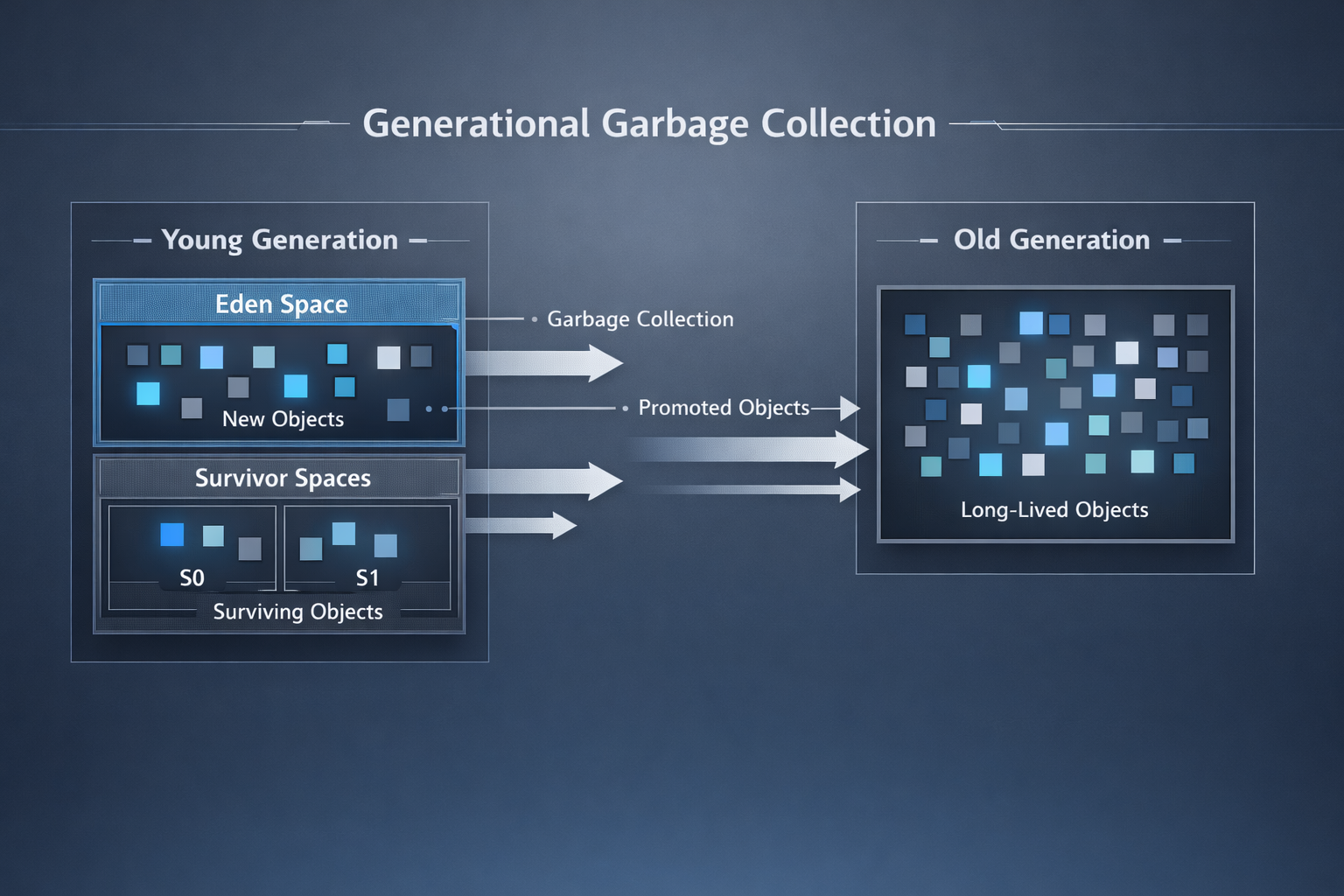
At this point, it is important to understand that a garbage collector does not usually treat all memory in the same way. Most modern collectors are based on what is known as the generational hypothesis. The assumption is simple, yet empirically effective: most objects die young, while only a small fraction live for a long time.
For this reason, memory is typically divided into generations. Young objects are collected frequently using lightweight cycles, while long-lived objects are promoted into older regions that are scanned less often but with heavier operations. As a result, not all garbage collection cycles are alike. Some are fast and barely noticeable; others are rarer but clearly visible.
From the developer’s perspective, this explains why certain allocation patterns feel inexpensive, while others suddenly produce noticeable delays. This is not random behavior, but a consequence of how object lifetimes align with the collector’s assumptions – or fail to align with them.
At the same time, developers often make a critical misassumption. It is tempting to believe that the garbage collector somehow understands the meaning of the code or the developer’s intent. In reality, it understands neither business logic nor semantics, nor when something is “conceptually” no longer needed.
The garbage collector understands references. If an object is reachable, it is alive. If it is not, it is garbage. That is the entire model, and there is nothing mystical behind it.
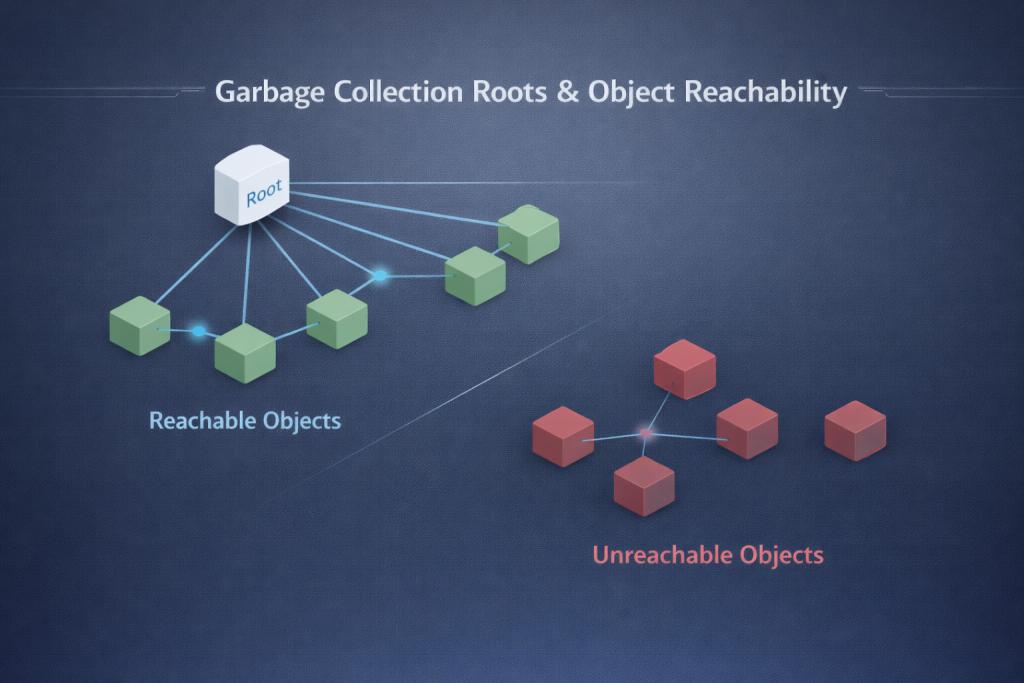
This leads to situations that often surprise developers. A single unintended reference can keep an entire object graph alive. In garbage-collected languages, a so-called memory leak usually does not mean that memory is never reclaimed; it means that objects are being kept reachable longer than intended. Once this is understood, many issues that previously appeared mysterious begin to look like logical consequences.
The Same Problem, Different Languages, Different Responsibility
Although the core idea behind garbage collection is consistent, different languages distribute responsibility in very different ways.
Java and Go are designed around garbage collection from the ground up. Developers can allocate objects freely, and the runtime takes care of reclamation. This often leads to cleaner code and faster development, but it also shifts part of performance control away from the developer. The collector makes decisions based on global heuristics rather than individual requests. The result is pauses, memory spikes, and occasionally behavior that is difficult to predict.
These pauses are commonly referred to as stop-the-world events. During such an event, normal program execution is temporarily halted so that the garbage collector can operate safely. All application threads are paused, memory is analyzed, and execution resumes only afterward. The duration of these pauses can range from almost imperceptible to multiple milliseconds or longer, depending on load and GC strategy. In the JVM ecosystem, a significant portion of performance tuning revolves around minimizing these stop-the-world intervals or moving them away from latency-critical paths.

This is not an exceptional condition or an error state. It is a deliberate part of the garbage collection model. Once developers understand this, latency spikes cease to be mysterious and instead appear as consequences of specific design choices.
In JavaScript, garbage collection is always present but easily overlooked. TypeScript amplifies this illusion. While TypeScript improves developer experience and type safety, it does not change the runtime in any way. Memory management behaves exactly as it does in JavaScript. TypeScript changes how developers think, not how programs execute, and forgetting this often leads to a false sense of control.
Python and PHP represent hybrid models, combining reference counting with garbage collection. Some memory is reclaimed immediately, while some is only freed during GC cycles. This creates the impression of greater determinism, but in reality the behavior is more complex. Different execution environments behave differently, and assumptions about when memory is released frequently turn out to be incorrect.
C++ and Rust provide a useful contrast. In C++, the developer bears full responsibility for memory management, which allows for predictable behavior at the cost of potential errors. Rust takes the idea further by shifting responsibility into the type system and compile-time checks. Ownership and lifetimes force developers to reason explicitly about the same concerns that garbage collectors handle automatically in other languages. The absence of a garbage collector does not make a language outdated; it makes responsibility explicit.
Why Understanding Garbage Collection Is Essential
Even if you never optimize low-level code or build real-time systems, garbage collection still affects your work directly. It influences response times, memory consumption, and how systems behave under load. Many production issues that appear enigmatic are, in reality, consequences of garbage collector behavior.
Once developers understand garbage collection, they begin to view problems differently. Debugging shifts from symptoms to underlying causes. Architectural decisions become more informed, and performance issues are placed in a broader context.
When stop-the-world pauses and generational behavior are considered together, a coherent picture emerges of why garbage collectors behave as they do. GC is not arbitrary; it optimizes against statistical reality. Problems arise when an application’s actual object lifetimes diverge significantly from what the runtime assumes.
In this sense, the garbage collector acts as a mirror. It does not create problems out of thin air. It reveals them.
Conclusion
The garbage collector is not an enemy, but it is not a magical mechanism either. It is an architectural choice that shifts decision-making from the developer to the runtime system. Once this shift is understood, many questions about program behavior begin to have clear answers.
Garbage collection does not free you from memory management. It changes where and when those decisions are made. If you do not understand that shift, you do not fully understand the nature of your software. If you do, the behavior of complex systems suddenly appears far more coherent and far less mysterious.