Libros
Trabajo de largo formato y libros próximos
Un catálogo indexado de libros publicados y futuros de Jan Theon – exploraciones de largo recorrido sobre tecnología, poder y sistemas complejos.
Los libros como pensamiento a largo plazo
Algunas ideas no pueden reducirse a artículos o ensayos.
Estos libros son exploraciones extensas sobre tecnología, poder, liderazgo y sistemas complejos, pensadas para contextos en los que los formatos breves no logran capturar la realidad.
Cada libro desarrolla su argumento con el tiempo, dejando espacio para matices, contradicciones y consecuencias no previstas. Algunos títulos ya han sido publicados, otros siguen en proceso.

Títulos publicados y próximos
-
CX Is Broken
Customer Experience has become a sophisticated form of corporate self-deception.
Organizations measure surveys, optimize dashboards, and celebrate improving scores – while customers quietly leave for reasons no CX framework can explain. CX does not fail because it is poorly implemented, but because it is built on a false assumption: that people can accurately report experience after it happens.
In an algorithm-driven world, experience is shaped before awareness. CX measures memory and narrative, not mechanism.
Once this is understood, the entire CX industry stops making sense.
-
Neuropsychology and Data
Neuropsychology and Data extends the argument introduced in CX Is Broken by examining customer experience at its biological and systemic foundations.
Rather than treating experience as opinion or feedback, the book frames it as a dynamic system state emerging from real-time interaction between human neurobiology and digital environments. What organizations capture as “customer feedback” is shown to be a delayed narrative reconstruction of processes that have already unfolded below conscious awareness.
The book provides a theoretical framework for understanding experience through signals, state transitions, and temporal dynamics, replacing retrospective metrics with models grounded in systems theory and cognitive neuroscience.
-
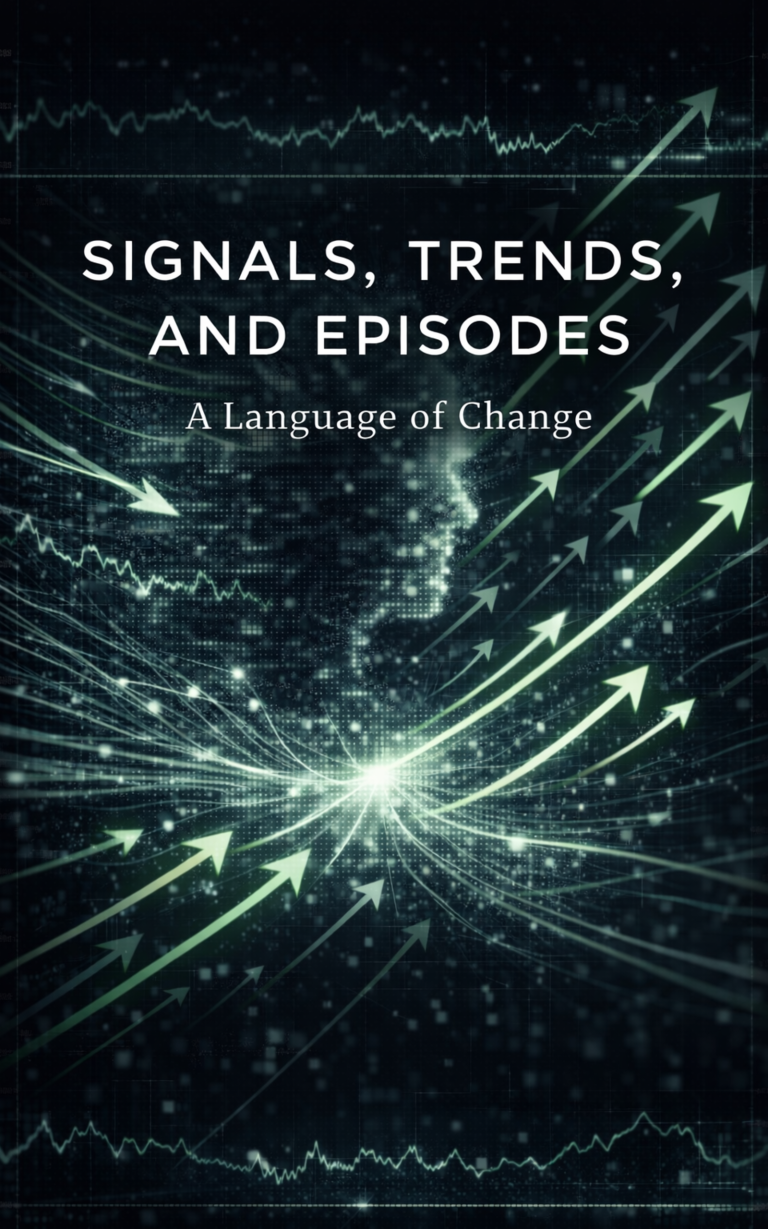
Signals, Trends, and Episodes
Signals, Trends, and Episodes reframes customer experience as movement rather than state.
While organizations continue to rely on averages, snapshots, and static dashboards, experience itself unfolds as continuous change within complex systems. This volume argues that information does not reside in states, but in transitions: in signals, trajectories, and accumulating patterns that emerge over time.
The book introduces a new foundational language for experience systems, showing how organizations can move from passive reporting to active control streams. Instead of explaining outcomes after the fact, it focuses on reading direction, momentum, and acceleration in real time – with the same precision that high-frequency trading systems use to interpret markets.
Experience is no longer treated as feedback to be summarized, but as a dynamic system to be observed, modeled, and guided as it evolves.
-
State Personas
Customer Experience has been built on the assumption that identity is stable. Personas persist, segments endure, and users behave consistently across time and context. This book argues that this assumption is not just outdated – it is structurally false.
Rather than treating identity as a fixed profile, State Personas reframes it as a momentary state emerging from signals, cognitive load, and environmental pressure. Decisions are not expressions of who someone is, but of what state they are in right now.
The book introduces a dynamic model of identity grounded in systems thinking, signal accumulation, and real-time interpretation. It explains why personalization based on history feels clumsy, why dashboards misread reality, and why products often respond to a user who no longer exists.
If your product speaks to a persona that isn’t there, it is speaking into a void.
State Personas teaches you to listen to signals instead.
-
Phantom Dynamics of Service Networks
The customer journey is not a real structure, but a story constructed after the fact.
It gives organizations a sense of control, yet fails to describe how experience, decision-making, and behavior actually emerge.
In reality, organizations do not operate along paths, but within networks – dynamic states in which small changes can trigger delayed, indirect, and unexpected responses. Cause and effect do not progress step by step, but are intertwined within complex systems that traditional service design and CX thinking cannot read.
This book dismantles the assumptions behind customer journey thinking and returns leader-ship from diagrams, metrics, and dashboards back to reality – where organizations actually move, react, and either fail or survive.
-
The End of Linear Thinking
Roadmaps do not fail because leaders are incompetent.
KPIs do not decay because metrics are poorly designed.
Projects do not collapse because teams lack discipline.
They fail because they are built on an assumption that the world is linear, predictable, and stable.
In reality, organizations exist in dynamic state spaces where small decisions compound, de-lays distort causality, and survival depends on response, not prediction. This book dismantles the language of control and exposes why modern management optimizes for reassurance rather than resilience.